

KINLOCH, Charles Walker; attributed to
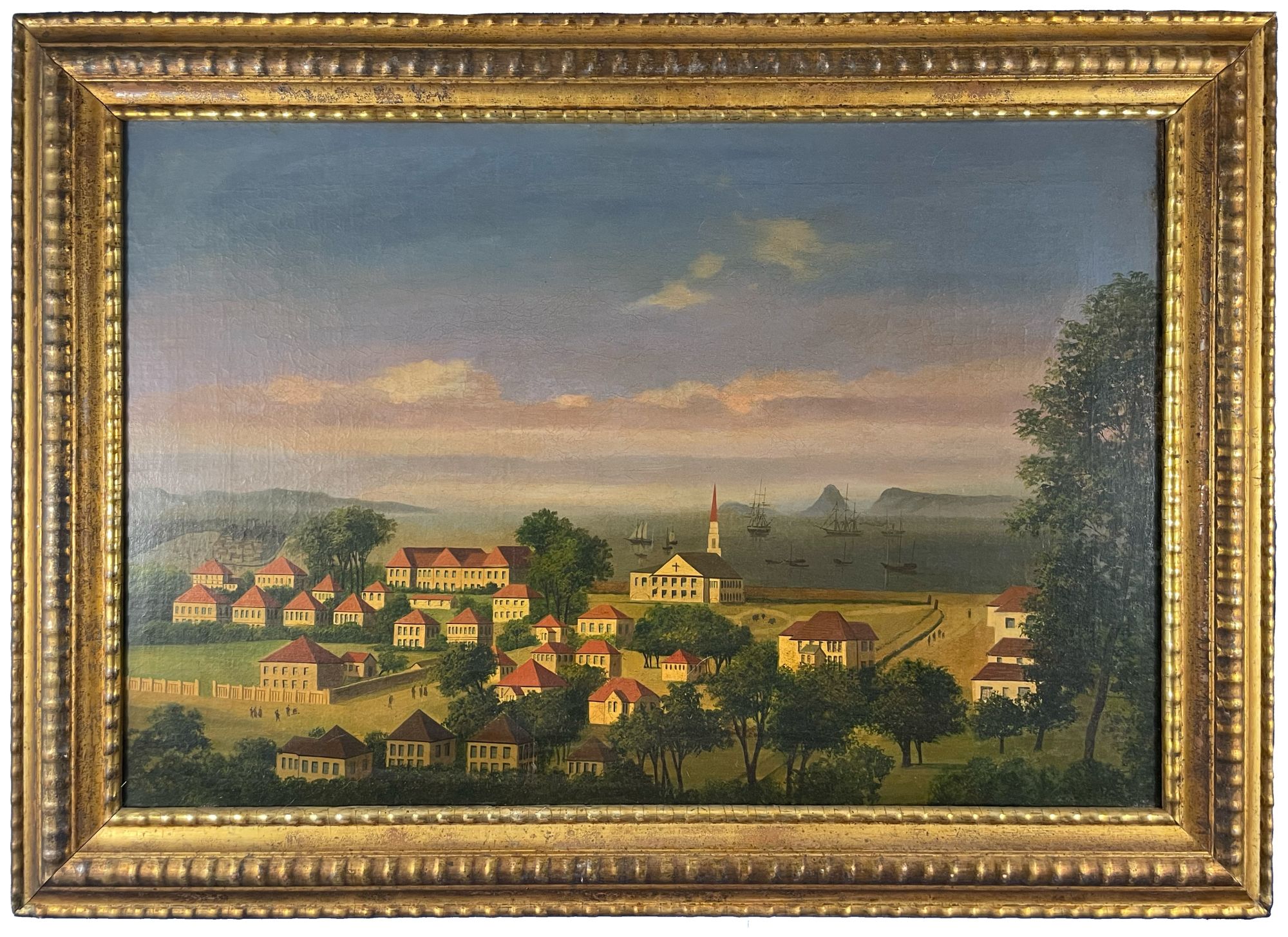
Singapore, from the East Side of Government Hill
[circa 1852]. Oil on canvas, title in ink on the stretcher, (19 7/8 x 30 1/8 inches), relined. In fine period gilt frame.
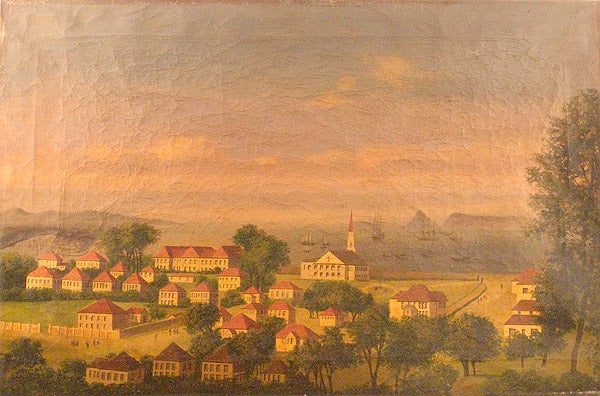
A rare and evocative early panoramic view of Singapore, depicting the settlement from Government Hill at a formative moment in its mid nineteenth century development.
The painting presents a panoramic prospect from the eastern side of Government Hill (Fort Canning), then the principal vantage point from which European observers recorded the expanding town. The composition looks across the Padang, the ceremonial and administrative heart of the colony, toward the harbour and the layered topography beyond. St. Andrew's Church occupies a central position, its Gothic Revival form rising prominently above the surrounding low rise buildings. To its left stands the Raffles Institution, while Coleman Street extends laterally to the right, providing a clear spatial framework for the European civic quarter. The foreground is articulated with cultivated greenery and dispersed figures, while the middle ground reveals a mixture of masonry and vernacular structures, reflecting the plural character of early colonial Singapore. In the distance, shipping in the roadstead and the faint outline of offshore islands attest to the port's rapidly increasing commercial importance. The vantage point corresponds closely to that described by Charles Walker Kinloch in De Zieke Reiziger; or, Rambles in Java and the Straits in 1852 (London, 1853), where he writes that "the best view of the town and the surrounding country is to be had from the summit of the Government Hill," commanding a wide prospect over the town, shipping, and adjacent hills. One of the plates in that work represents a closely related view, and Bastin and Brommer note that the illustrations in the book were presumably after drawings by Kinloch himself. The present painting appears to relate directly to that image, either as its source or as a closely associated version. The work records Singapore at a moment of consolidation within the Straits Settlements, when its institutional architecture, urban layout, and harbour traffic were becoming established features of the colonial landscape. It survives as a rare painted view corresponding to a known printed source and as an important visual document of the city in the early 1850s.
Cf. Abbey Travel II, 556; cf. M. Teo, Yu-Chee Chong and J. Oh, Nineteenth Century Prints of Singapore, Singapore, 1987, p.85, pls 30-3; Cf. Bastin and Brommer, 406n.
Item #20732
Price: $38,000.00